
With the Norman conquest and the alliance between the monarchy and the clergy, strengthened by the coronation of Roger II as King of Sicily (1130), Palermo became a construction site aimed at consolidating, through material structures, the authority of the crown and of the bishop’s chair . The Normans, in fact, having arrived in Sicily after more than two centuries of Arab domination, took possession of the buildings previously built and modified them, not preserving evidence of the public monuments of the Arab era. Despite this, the competition of Arab, Byzantine and Latin workers saw an extraordinary architectural synthesis flourish, of which the Palatine Chapel and the Cathedral of Monreale are the maximum expression. Thus unique places were born, such as the Cathedral of Palermo and the Royal Palace with the sumptuous Palatine Chapel, the Zisa Castle, the churches of Santa Maria dell’Ammiraglio, San Cataldo and San Giovanni degli Eremiti, in which the Latin or Greek architectural systems they are embellished with Arab ornaments – such as the alveoli and stalactites called “muqarnas” – and the palaces are surrounded by gardens and expanses of water, decorated with fountains and mosaics.
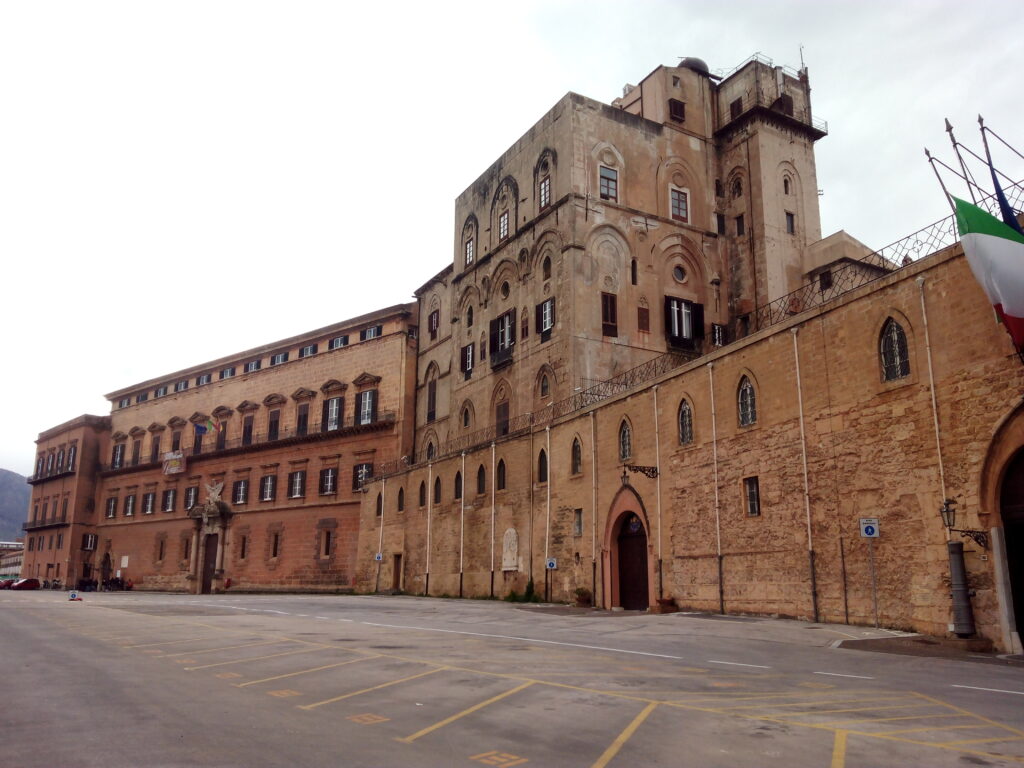
Among the important monuments of this era – of which we find representations inside the rooms of the GAM – there are the glimpse of Palazzo dei Normanni taken by Michele Catti, the Zisa Castle taken by Carlo Perna and San Giovanni degli Eremiti and its Cloister , works by Rocco Lentini and Giovanni Lombardo Calamia.
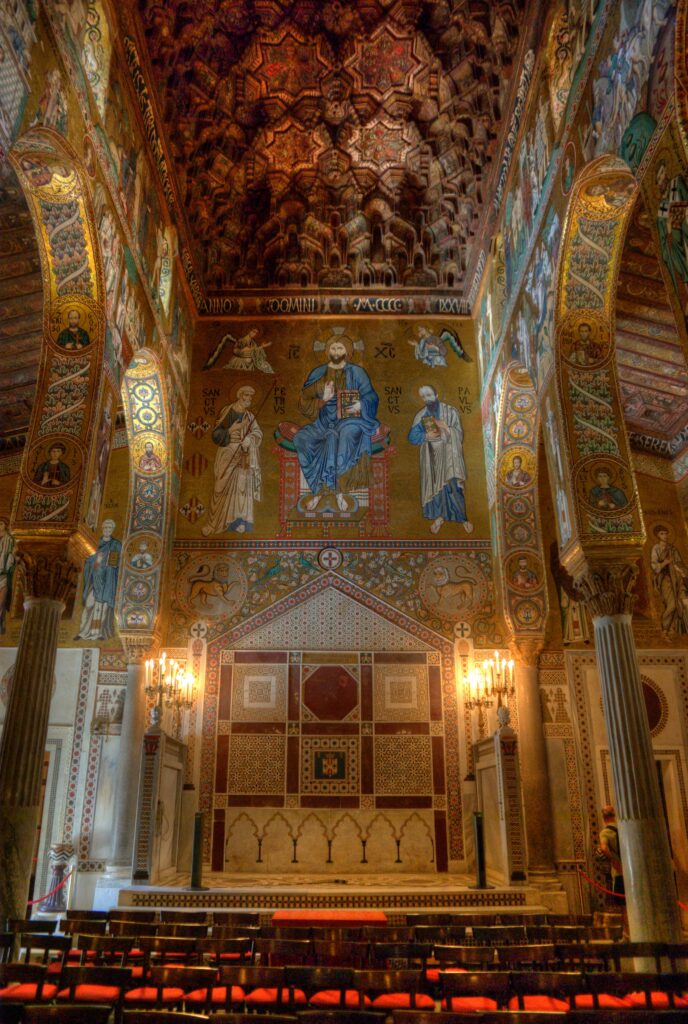
The Palatine Chapel is located inside the Royal Palace, located at the highest point of the city and which rises above the first Punic settlements of Palermo, as narrated by the basement of the factory, but it was also built on the remains of a previous structure from the Islamic age . The Norman kings transformed it, right from their first settlement, into an executive and residential center, therefore a symbol of the power of the monarchy. It was Roger II, crowned king of Sicily in 1130, who ordered its construction and embellishment to make it his own palace: he is responsible for the most representative buildings such as the Greek Tower, the Pisan Tower, the Joharia and the Chapel Palatina, the best example of cultural syncretism of the Norman era. Consecrated in 1140, the different genres belonging to the Islamic, Byzantine and Western figurative culture make the Chapel the most representative example of Mediterranean arts in Norman Sicily. The flooring shows an extraordinary marble decoration in opus sectile, while the mosaics of the decorative cycle are heirs of the Byzantine tradition. The oldest depict scenes from the life of Christ, Saints, Prophets and Evangelists and the image of Christ Pantocrator in the apse and dome, while the more recent ones, those in the naves, dating back to the reign of William I and William II, illustrate episodes from the Old Testament in the central nave and scenes from the life of Saints Peter and Paul in the lateral naves.
On the wall opposite the altar is the space intended for the king, the royal throne, raised by five steps; above is the mosaic with the imposing figure of Christ enthroned between Saints Peter and Paul, dated to the reign of William II (1166-1189). The three naves are covered by wooden ceilings, painted by Muslim artists: an extraordinary wooden muqarnas machine of the central nave, which contains the largest complex of Islamic paintings from the Middle Ages that has been preserved. The painted decorations tell scenes and characters of profane subjects (musicians, drinkers, dancers, wrestlers) to be traced back to the so-called “cycle of the prince’s life and the pleasures of court life”, typical of the figurative culture of Islam. The period between the mid-13th century and the second half of the 16th century was characterized by turbulent political events and the Royal Palace lost its role as the privileged seat of the sovereigns who preferred other seats, such as Palazzo Chiaramonte (more commonly known as the “Steri”) or the fortress of Castello a Mare, both located towards the coast.
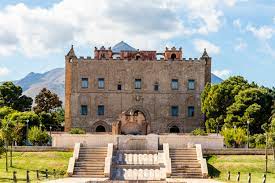
The Zisa Castle was built under the reign of William I and completed under that of William II between 1165 and 1167. It was a summer residence created near the city for the rest and recreation of the sovereign; in fact it was surrounded by a garden, a fishpond and a thermal structure. The Normans, who took over the domination of the island from the Arabs, were strongly attracted by the culture of their predecessors. The sovereigns wanted rich and sumptuous residences like those of the emirs and organized court life on the model of the Arab one, also adopting its ceremonial and customs. Thus it was that the Zisa, like all the other royal residences, was built in the “Arab” manner by workers of Muslim extraction, looking at the palatial building models of northern Africa, confirming the strong ties that Sicily continued to have, at that time, with the Islamic cultural world of the Mediterranean basin. The name Zisa probably comes from al-Aziz, the shining one. From the large archway you enter the most important room, that of the Fountain, with a cruciform plan, decorated with muqarnas (alveolar vaults) in stucco, with mosaics by Byzantine craftsmen depicting trees, peacocks and hunters and with a fountain that symbolically reproduces a salsabil, an environment in which the presence of a spring recalls one of the watercourses of the Koranic paradise.
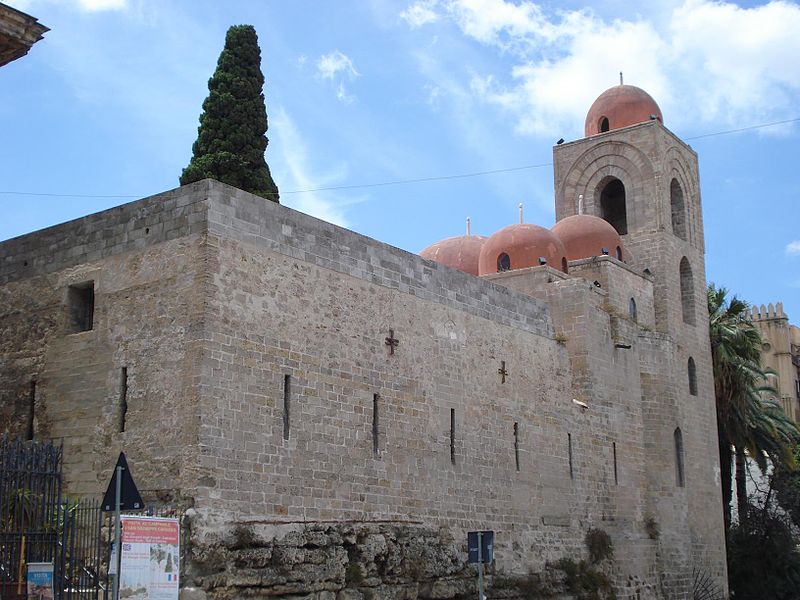
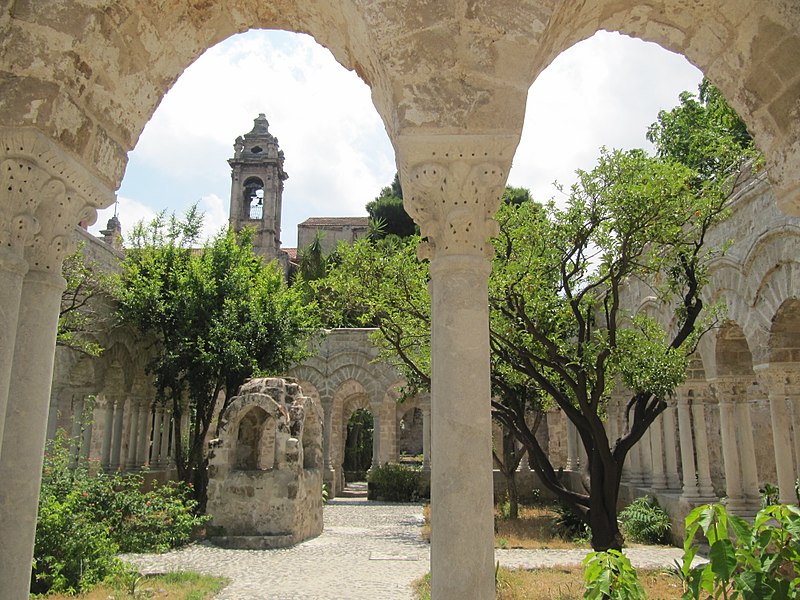
The Church of S Giovanni degli Eremiti and its cloister are among the best known monuments of Arab-Norman Palermo, which Roger II had built in 1136. The complex stands just below the walls of the Royal Palace and is known for its five characteristic domes red. From the outside it has a compact volume of squared limestone ashlars. Its famous cloister is a square-plan structure (47×47 m.) located inside the garden of the church of the same name which belonged to the original Benedictine convent of the late Norman age. Its structure exemplifies the spatial conception of the Fatimite culture: geometric shapes which, in their primordial simplicity, express the divine, such as the square, the cube and the sphere. Their union is an artistic hymn to the concept of life.
Its spaces are marked by ogival arches resting on paired and inlaid columns; the harmonious balance of the space is embellished by a second, smaller cloister, which contains a fountain in the centre: also square, it protrudes towards the inside of the main cloister. The fountain is entirely clad in light marble and has a round basin, from which rises a column in the shape of a palm tree, surmounted by a marble sphere on which standing figures, heads and leaves stand out in relief: the water gushes out in thin jets from human and lion mouths.