
In the Gallery there are numerous portraits capable of capturing those movements of the soul in the faces, which are in close relationship with the intensity of psychological and emotional participation of the portrayed character.

In Giuseppe Patania’s Portrait of an Infirm Priest from 1838 there are no facts to tell but only a human condition. It is a suffering man, as denoted by the red eyelids, the swollen and dry lips, the head slightly bent forward, who bears his illness with resignation and patience.
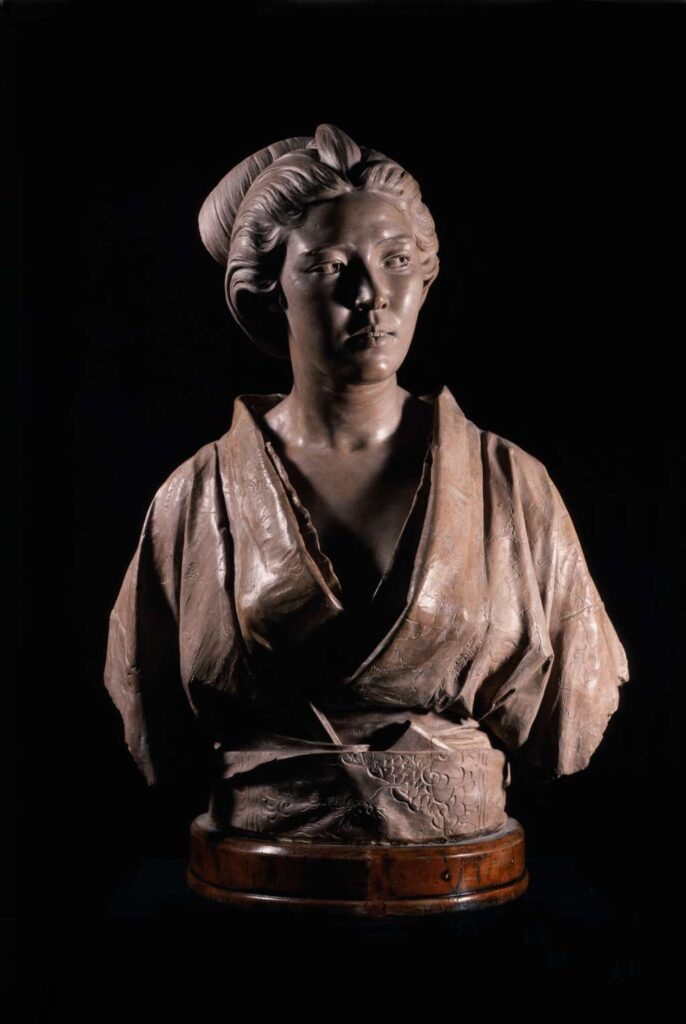
A terracotta portrait in the Gallery can be defined as a love letter. This is what Vincenzo Ragusa did in the Portrait of Eleonora ‘O Tama Ragusa (1883), his very young portrait in a traditional Japanese dress, the yukata, an informal chamber dress, softly open on the chest and evocative of a Mediterranean sensuality , with the obi cinched at the waist, the wide belt that knots at the back, and the fan and her artist’s notebook highlighting this woman’s activity and cultural exceptionality. Finally, her face takes up and enhances the sharp and sweet gaze of this young woman.
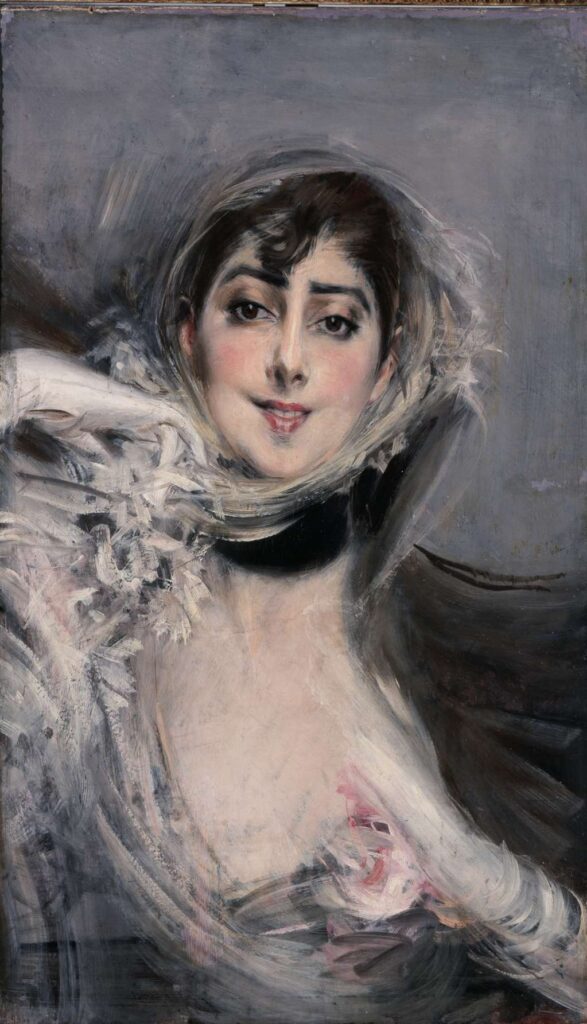
Of a completely different tenor, but aimed at enhancing the grace of a young woman is the portrait entitled Femme aux gants (1901) by Giovanni Boldini, a sophisticated artist from Ferrara, who thanks to his technique and his talent was able to make the sensitivity , the gestures and the psychological profile of his subjects in the intimate secrets of the looks. In this case, the painter creates the portrait of Emiliana Concha de Ossa, a very young, elegant South American lady. Here she is portrayed half-length, her dress is painted with quick strokes of color, a veil, which she holds with her gloved hand, surrounds her smiling face, whose expression is that of a still naive and fresh youth.
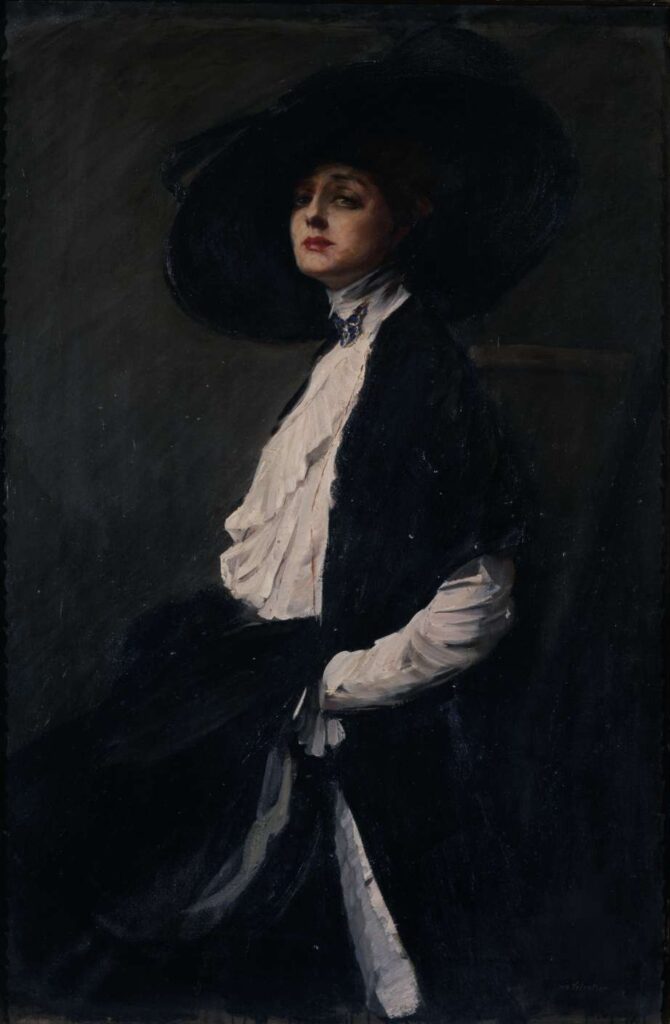
Further praise to female beauty can be found in the Portrait of Mrs. A. C. (1912), by Lino Selvatico, which highlights – underlined by the dark background of the large hat that puts the made-up eyes in shadow – the sophisticated and serious face and the bored expression of this woman. Her elegance – in the almost entire figure – is enhanced by the black dress she wears from which a pleated white scarf and white sleeves painted with broad brushstrokes emerge.
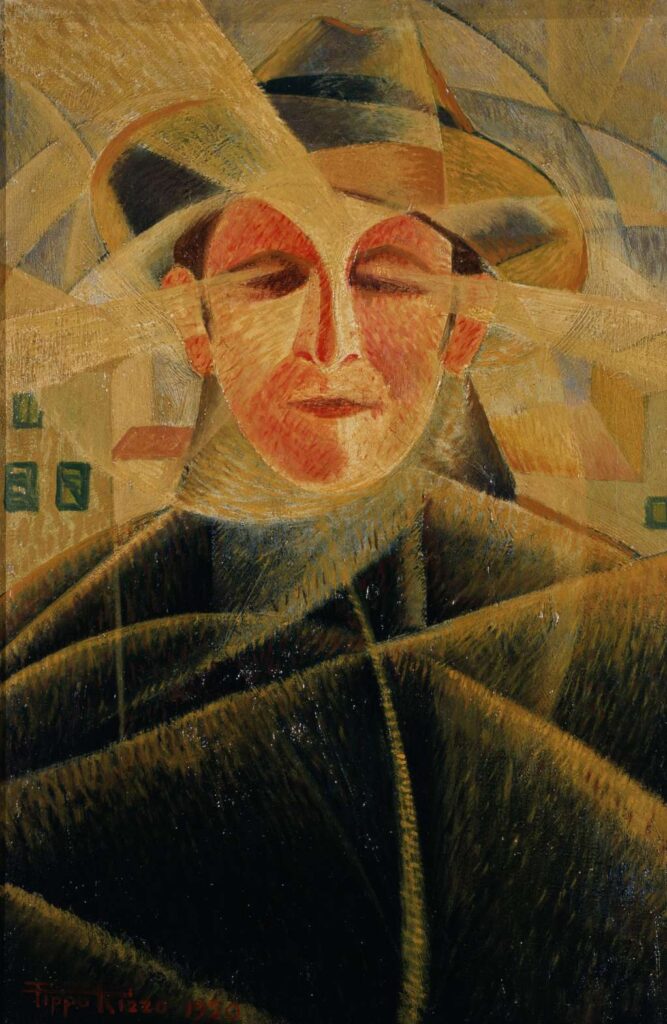
Even the modernity of the first decade of the twentieth century translates into the portrait genre, as in the work of Pippo Rizzo, exponent of Futurism in Sicily, who in his Figure, light, atmosphere (Psycho-dynamic portrait) (1920), gives us a “decomposed” figure, built through the superimposition of luminous planes that start from the center of the face. It is a man wearing a hat, but the movement is given by the beams of light that cross his face, showing the experimentation, but also the complexity of modern man.
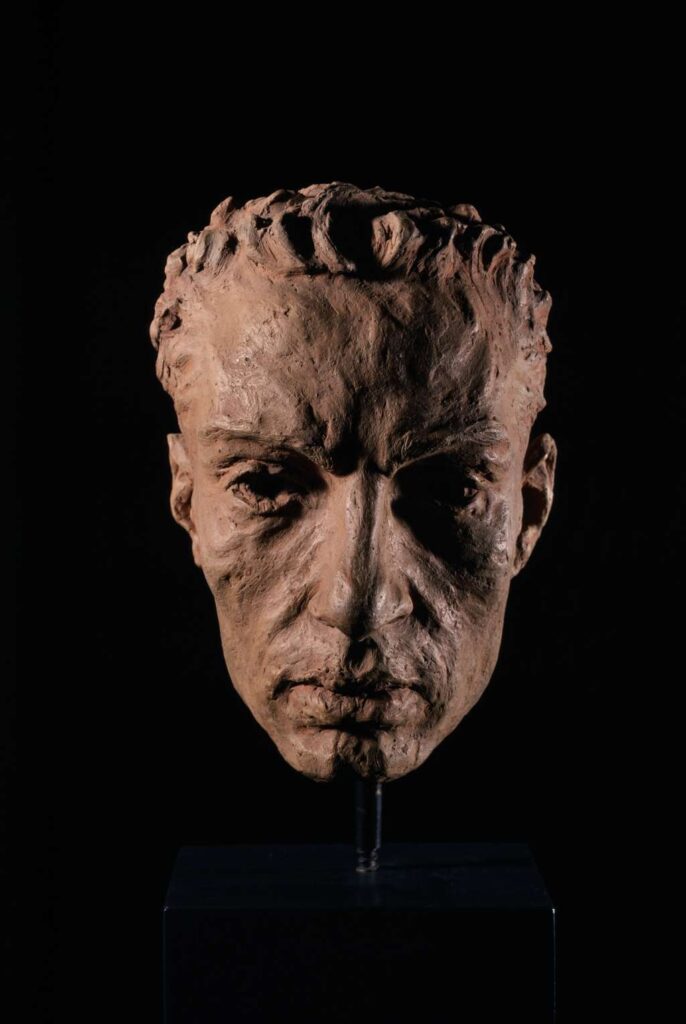
More and more over time the portrait tends, as in the thirties of the twentieth century, to manifest the character and feelings of the portrayed figure, the facial expressions and character. These characteristics are found, for example, in the terracotta sculpture created by Nino Franchina, an artist who is a member of Il Gruppo dei Quattro, entitled Portrait of Guttuso (1935). Here the features of the young Renato Guttuso, iconic twentieth-century artist and member of the artistic group, appear intense and marked and highlight the strong-willed and decisive character of the protagonist