
Antonino Leto, apart from some views of the Sicilian coasts, will instead dedicate a large part of his views and seascapes of the Neapolitan seafront, such as Mergellina or Torre del Greco where he sets his famous work, I funari di Torre del Greco, of which the GAM preserves the studies carried out at the beginning of his stay on Capri, his refuge in which to physically unwind and where to create freely.
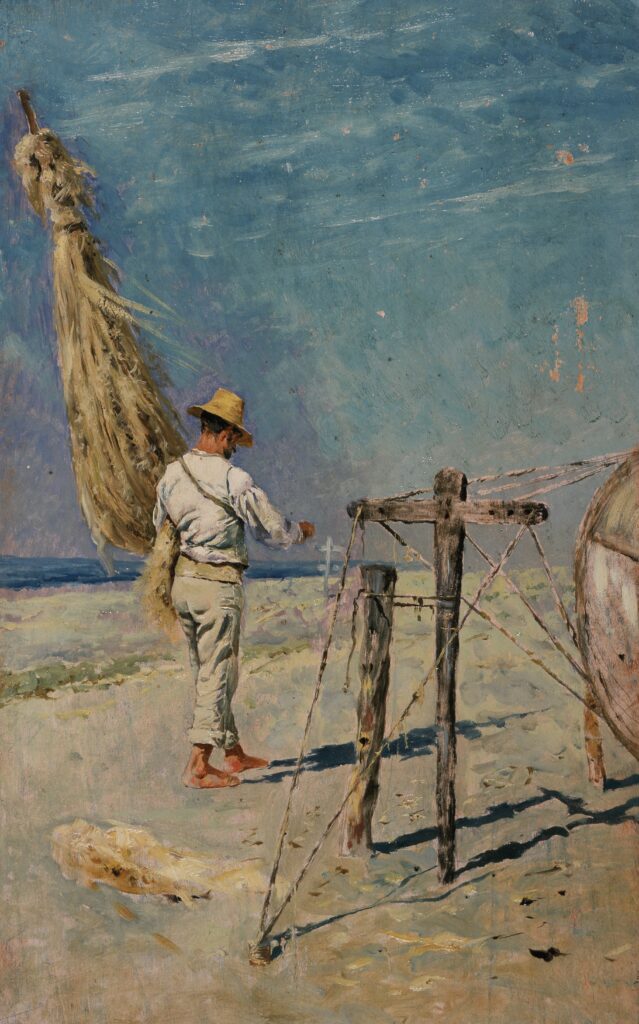
Antonino Leto, Studio per “I Funari di Torre del Greco”, 1883 ca., oil on canvas
In Sicily, on the other hand, Leto – at the suggestion of the Florios – dedicates an early work to the coast on which the Marsale winery falls and a later work dedicated to the marvelous coasts of Trapani, characterized by the white mounds associated with the salt harvest: The salt pans of Trapani (1881 ca.) which bears witness to the evolution of his artistic career, by now increasingly linked to European naturalism and the realist sentiment of Giovanni Verga. A vast view punctuated by piles of white salt and on the horizon, where sky and sea merge into a pastel-toned mist, and the outlines of the Egadi islands barely emerge.
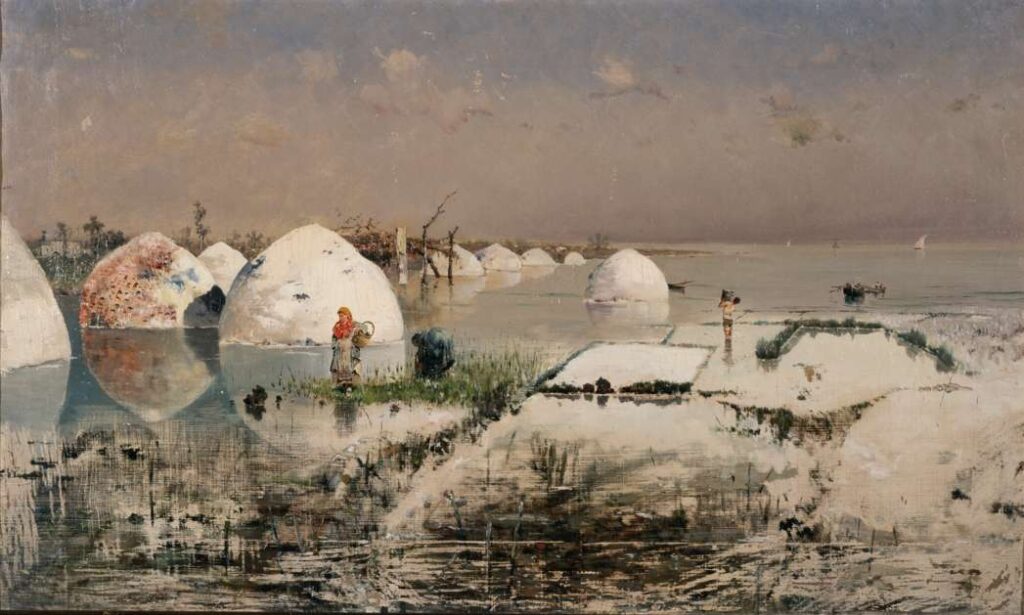
Antonino Leto, Saline di Trapani, 1881 ca., oil on canvas
Finally, in Capri, Antonino Leto, free from the pre-established schemes of art and the market, creates his most poetic works, inspired by the sea and in which the artist studies the expressive power of color and light to highlight the poignant beauty of Mediterranean nature, as in the Red Grotto, in which, wrote Maria Accascina, “the rock that falls on the water is painted with the same tender tones of a human skin: pink and liliaceous with black scars of shadow, rock that knows of flesh, of warmth, like a living woman, imprisoned between slabs of emeralds and sapphires”.
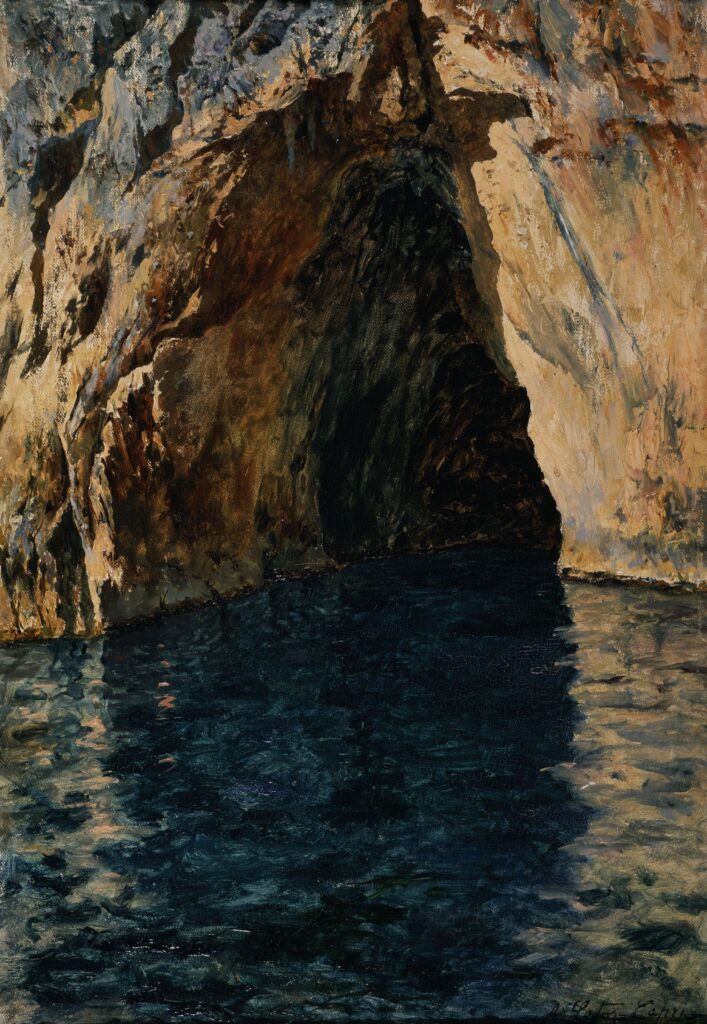
Antonino Leto, Grotta Rossa, 1882 ca., oil on canvas