
In the second half of the nineteenth century, studies on the Arab-Norman civilization flourished, thanks above all to the scholar Michele Amari who published the “Arab-Sicilian Library”, “History of the Muslims of Sicily” and other important works which spread great interest in Sicily for these extraordinary historical and artistic testimonies.
The artists, active in Palermo at that time, thus competed in reproducing the symbolic monuments of the city, which would shortly be subject to restoration work.
First was Francesco Lojacono, who painted the church of San Giovanni degli Eremiti, in a now lost canvas. The building is one of the most popular and reproduced places, which became a national monument in 1864, following the suppression of religious orders. The layout shows an architecture without decorations, with raw cut windows on the walls, with large square bays juxtaposed and surmounted by domes. We find two testimonies of this exceptional building through the eyes of two painters from the Gallery of Modern Art. In fact, the suggestive charm of its cloister and the refinement of its architecture are represented in two works: the canvas by the young Rocco Lentini, which depicts the church from a lateral point of view on the apse, and that by Giovanni Lombardo Calamia, concentrated on the cloister.
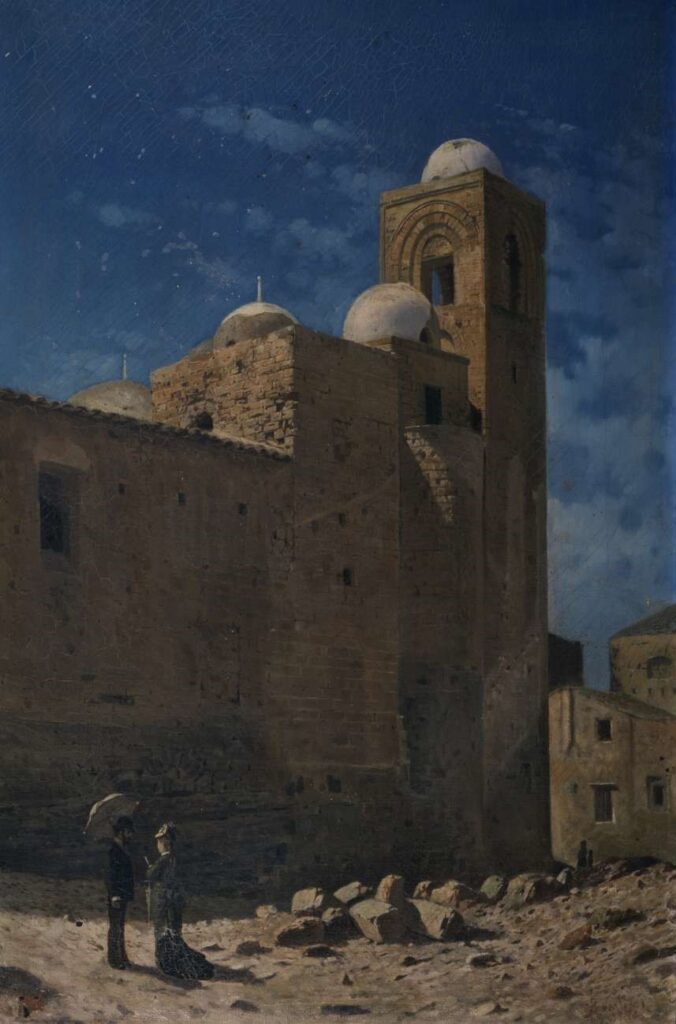
Rocco Lentini, San Giovanni degli Eremiti, 1876
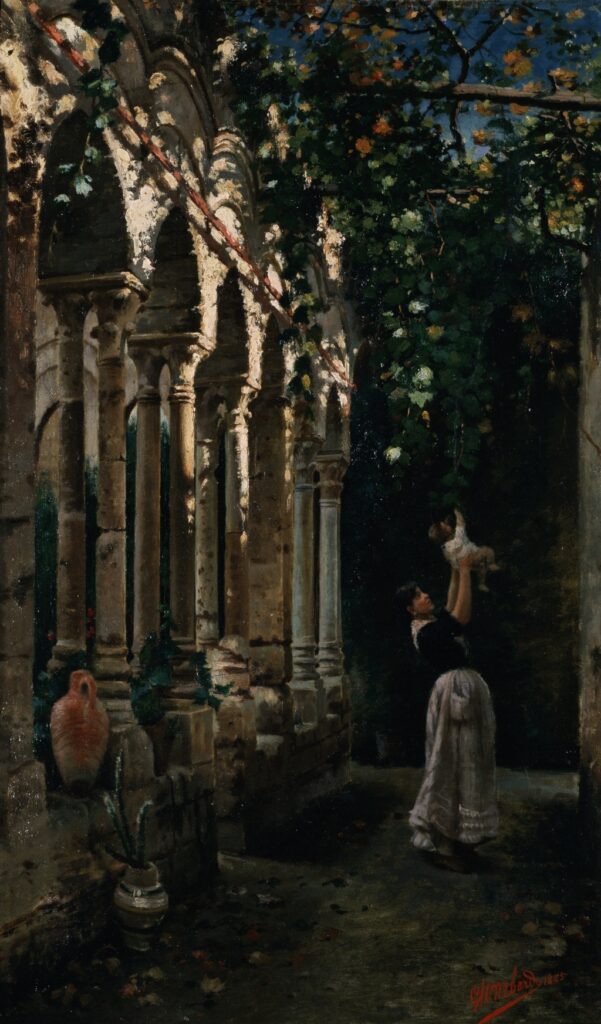
Giovanni Lombardo Calamia, Chiostro di San Giovanni degli Eremiti, 1885
The first work, of great aesthetic quality, also constitutes a precious visual document, since it shows us the church as it was before the restoration carried out by Giuseppe Patricolo: in fact, we do not see the trifora, restored later by the architect, and the now characteristic dark red color of the domes.
In the afternoon sun, a man and a woman are wandering around the church, among the rubble of buildings recently demolished to allow them to enjoy a better view of the “beautiful jewel” – as someone said – while waiting to begin the restoration of the tower of the Bell tower.
The beautiful cloister of the church had an exceptional fortune among the painters of the time, which we see reproduced in the Calamia painting, depicting precisely one side of the cloister where a mother plays with her child.
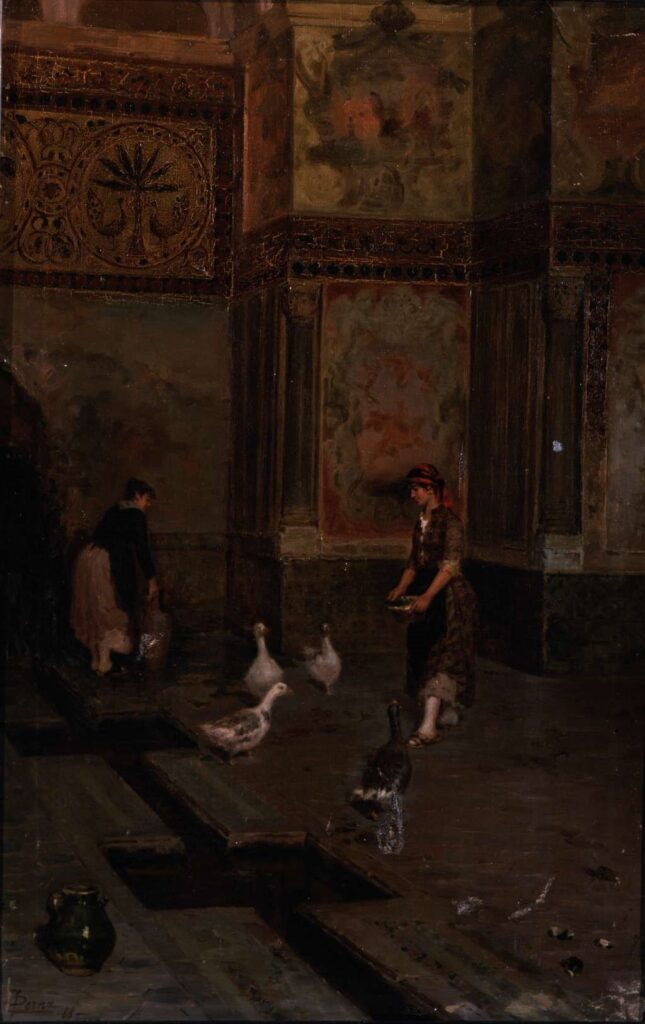
Carlo Perna, Interno del castello della Zisa, 1888
Instead, the work of Carlo Perna belongs to the genre of urban views in a “picturesque” key, full of contrasts between superb wealth and popular poverty, almost a synthesis of the city, immortalized in the painting Interior of the Zisa Castle: we see the Sala della Fontana, fulcrum of the building and place dedicated to the “meeting with the guest”, seen from the vestibule of the Zisa Castle. The room, with the water channel that crosses it, expresses that commendable synthesis between nature and architecture that distinguishes these exceptional creations of the Arab-Norman. The artist’s admiration lingers on the details, faithfully reproduced: the small basins that open along the canal, the decorations on the floor and walls, the muqarnas that decorate the vaults, the mosaic panel of the “Royal Hunt” at the bottom of the wall. A dazzling richness, which forms the backdrop to a humble scene of everyday life.