
Since its origins, the city of Palermo has developed a deep bond with its sea, a fundamental element in the life and history of the city. Chosen by the Phoenicians in the 7th century BC. for the creation of an important commercial port projected onto the Tyrrhenian Sea, Palermo was for centuries a city that based its identity on the sea.
Witness its five seaside villages, rich in history and centuries-old traditions and which based their economy on fishing, including tuna: Acquasanta; Arenella, Virgin Mary, Sferracavallo and Mondello. Places also taken up by the painters of the Gallery for their beauty and today strongly transformed by building speculation.
In fact, today the link between the city and its sea appears controversial, as evidenced by the story of the southern coast of the city, with an almost definitive loss of its peculiarity of seafront and seaside resort of great beauty. Today, this coast of Palermo – which has become a “non-place” – awaits profound redevelopment, but in the 19th and first half of the 20th century it was very popular with residents and tourists, experienced and portrayed precisely in the works of GAM painters.
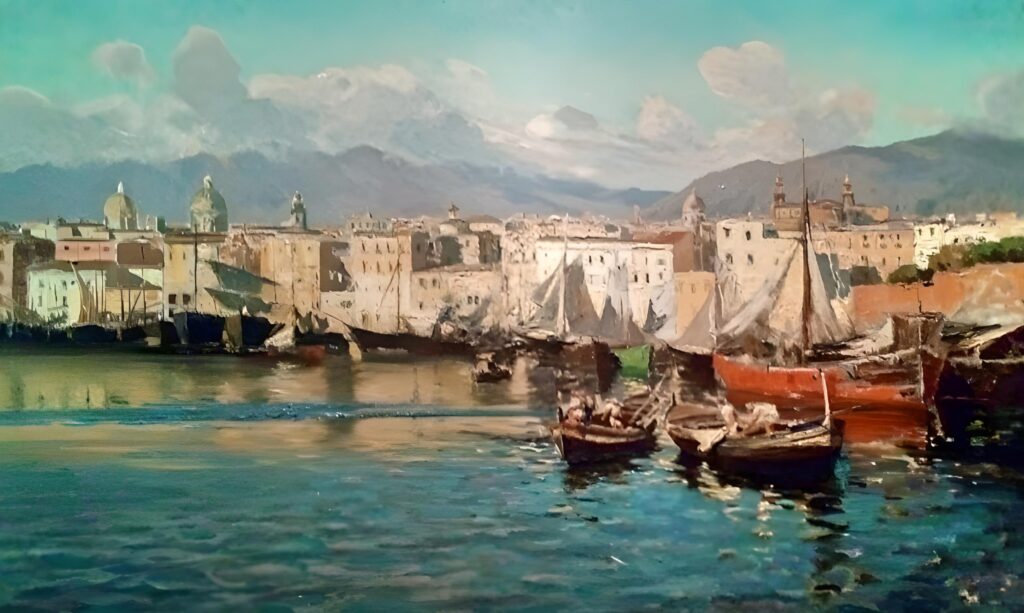
Ettore de Maria Bergler, Vecchio Porto, 1909, oil on canvas
Protagonists of excellence of numerous canvases that portray the surroundings of Palermo are the rocky coasts enclosed by large mountains and the splendid crystalline sea. In almost all these works there are elements that make the gulf of Palermo recognizable to us, seeing Monte Pellegrino or Capo Zafferano from a distance or, again, the profile of the roofs of churches and palaces in the historic city center, as in the masterful view of the Cala di Palermo, Vecchio Porto by Ettore De Maria Bergler, a great interpreter of the city’s artistic season between the 19th and 20th centuries.