
At the GAM, the undisputed protagonist of landscape painting in Sicily is Francesco Lojacono, the “thief of the sun”. Lojacono studied for a long time in the atelier of the Palizzi brothers in Naples at the Macchiaioli in Florence.
His landscape painting is placed in a timeless dimension, paying attention to experiments on life. The nineteenth century, in fact, has been called “the century of nature”, since in painting the landscape is analyzed with the eyes of science: atmospheric elements, topographical connotations, but also inspiration and aesthetic exploration.
In Lojacono’s works the nature and landscapes of Sicily come back to life as well as the special relationship that the artist has with Palermo and its surroundings: the smiling nature, the foaming sea, the Conca d’Oro and the atmosphere of a city that is slowly heading towards modernity.
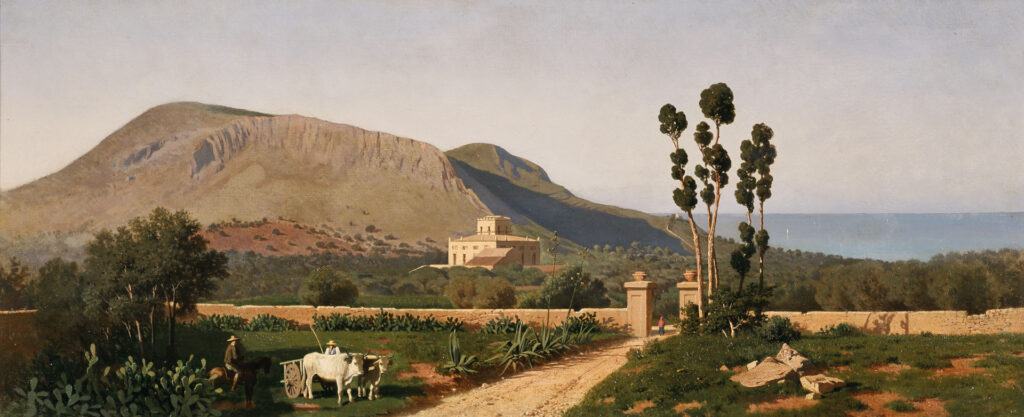
Francesco Lojacono, Veduta di Monte Catalfano, 1865-1870, oil on canvas
Works such as View of Monte Catalfano (1865-1870) illustrate this idea of landscape painting well, in which the dimension of the horizontal format – of a photographic type – shows all the elements present in nature, the plain and the mountains, the agaves and prickly pears, flooded by a crystalline light, together with the cart with the oxen and two peasants and a woman who timidly enliven the scene.
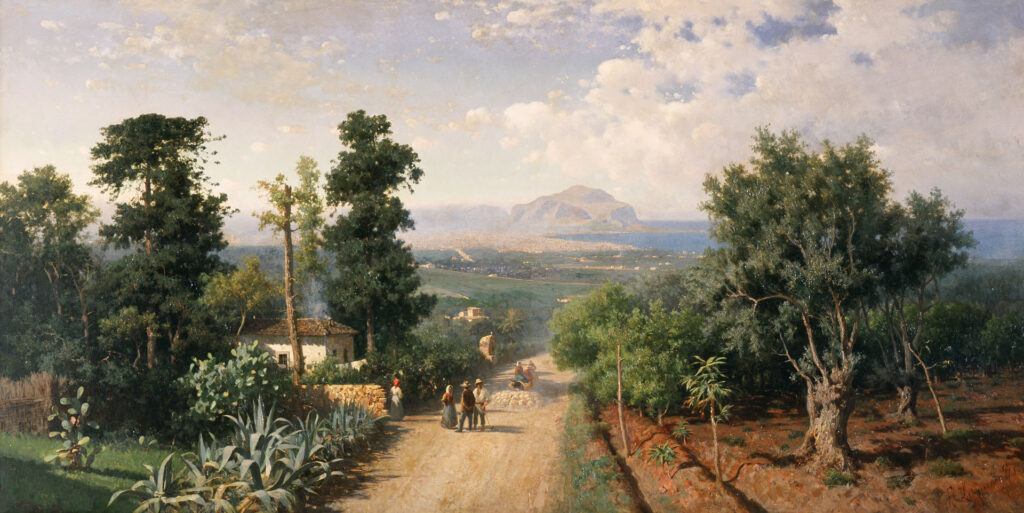
Francesco Lojacono, Veduta di Palermo dallo stradale di Santa Maria di Gesù,1875, oil on canvas
One of the best known and most significant canvases is View of Palermo (1871), which enhances the landscape of the Conca d’Oro, represented with great precision and richness of detail. In the background of the picture you can see the city, happily located between the greenery, the sea and the airy sky.
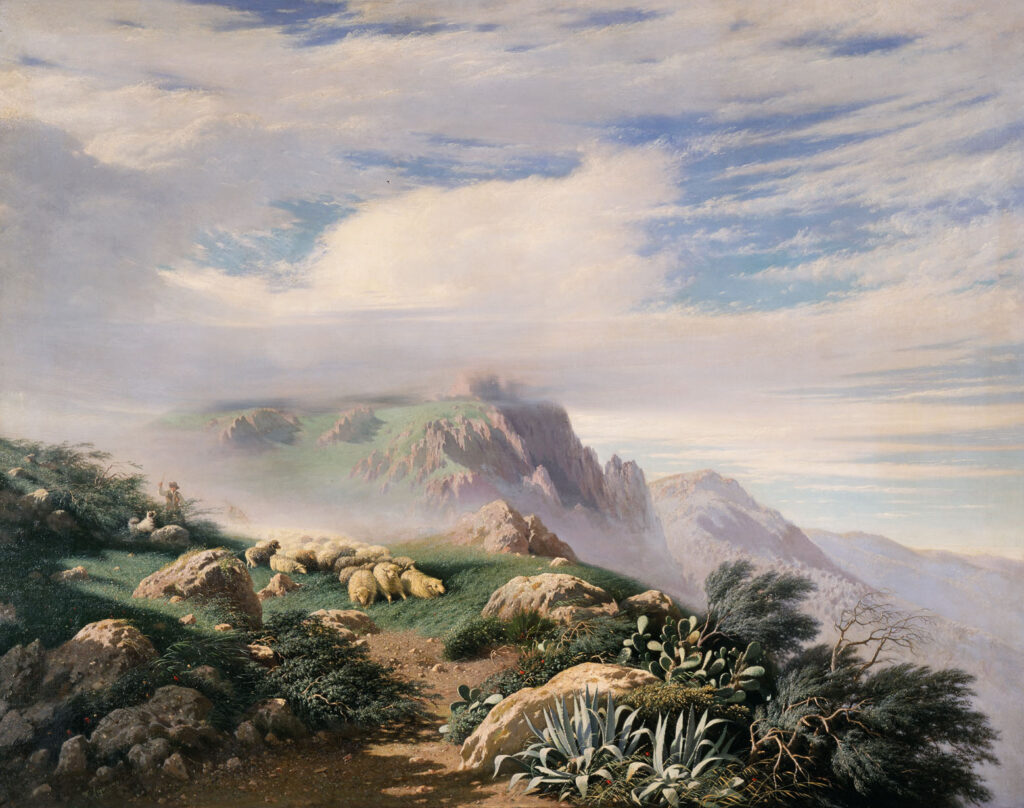
Francesco Lojacono, Vento di montagna, 1872, oil on canvas
The phase that looks at the seasons and atmospheric agents corresponds to Vento di Montagna (1872), in which the wind is the protagonist, cloaking figures and vegetation.
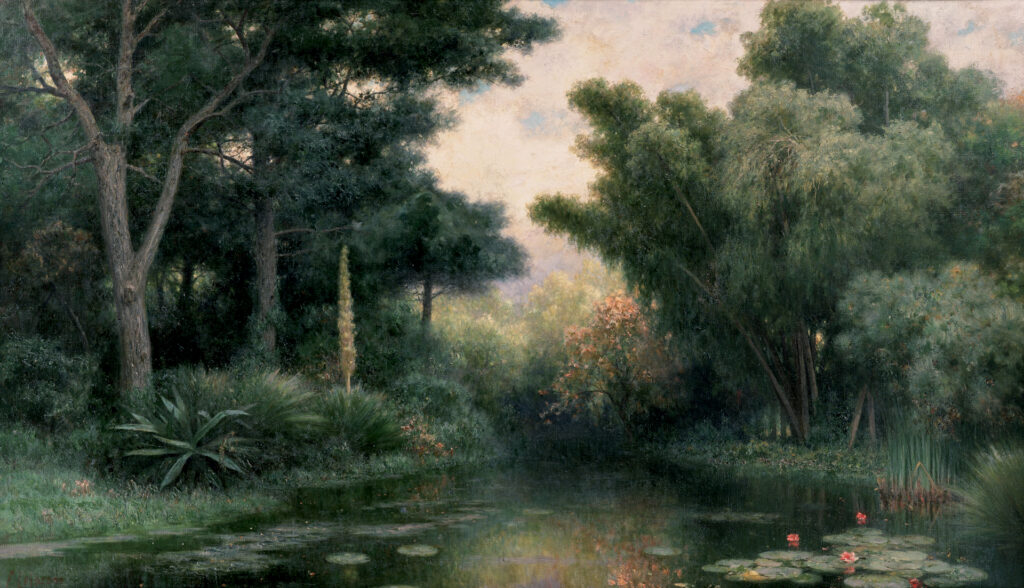
Francesco Lojacono, Autunno sull’Anapo, 1907, oil on canvas
As he gets older, Lojacono’s brushstroke becomes less meticulous and descriptive and concentrates on the idea of representing the landscape as a “state of mind”: stagnant waters, dense vegetation and foliage are among the protagonists of works such as Vasca con leaves (about 1897) which portrays the aquarium of the Botanical Garden of Palermo or Autumn on the Anapo (about 1907), a work enveloped in a feeling of melancholy.