
The section dedicated to the twentieth century in Sicily opens with the works of the most important exponent of Futurism in Sicily, Pippo Rizzo, who joined the movement in Rome and came into contact with the group led by Balla. Back in Palermo, he tried to collaborate with young artists of the group of Independent Sicilian Artists and to bring innovation to art in Sicily.
His work obtained important acknowledgments, such as Marinetti’s invitation for the Futurist room at the 1926 Biennale or the organization of the National Exhibition of Futurist Art in Palermo, inaugurated by Marinetti himself and with the participation of the most significant representatives of the movement.
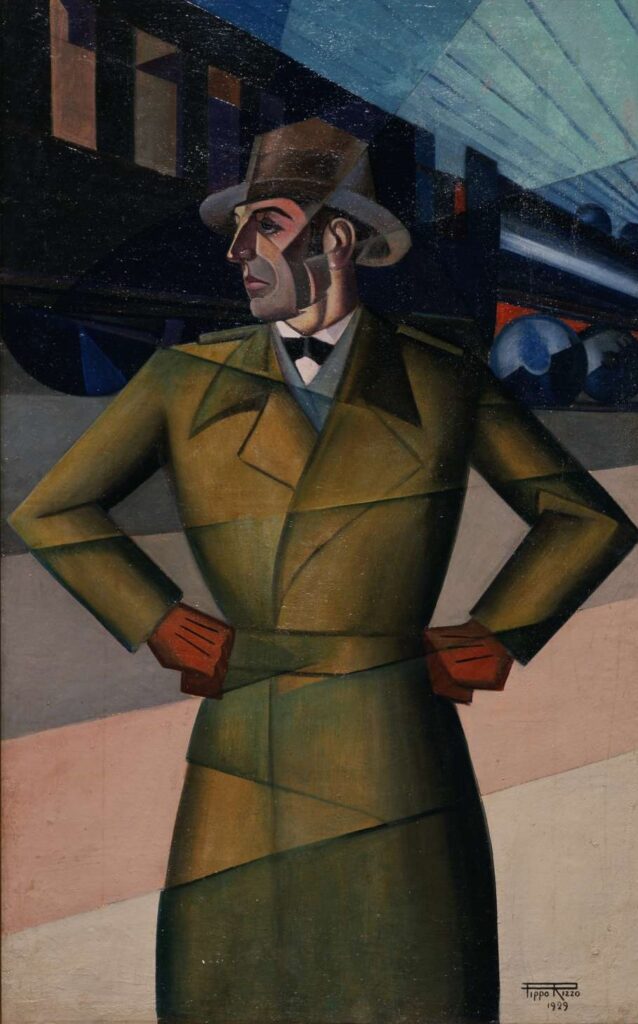
One of his declarations of artistic modernity is expressed in Il nomade (1929), an emblematic depiction of contemporary man: a modern dandy portrayed in an energetic pose behind which stands a glittering and metallic running locomotive. The protagonist’s tired and melancholic gaze contrasts with the brightly colored elements of the composition.
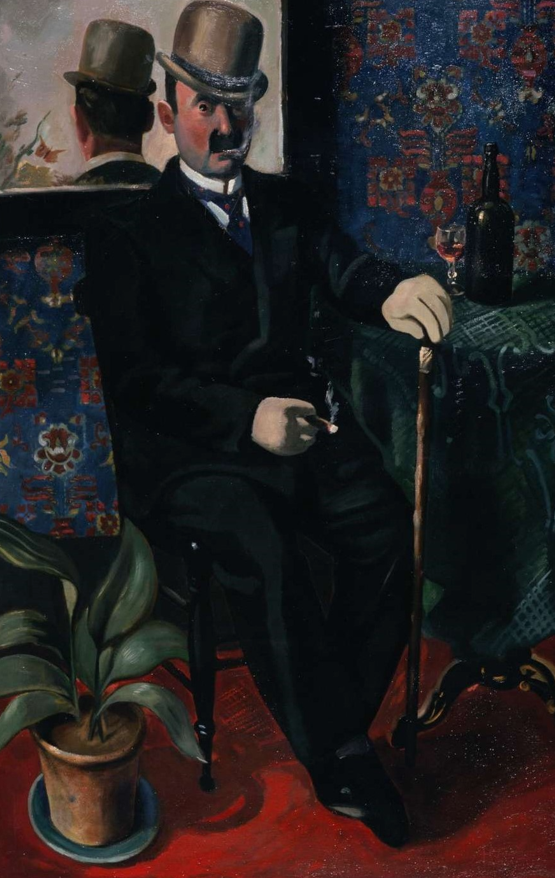
Alberto Bevilacqua, L’elegantone, 1928, oil on panel
The two works by Alberto Bevilacqua from Palermo, an intense and original artist of the group of “Independent Artists”, refer to the German Expressionism of Dix and Grosz and to the modern Ecole de Paris. With The horse trainer (1927) he made a name for himself at the Venice Biennale and certainly worthy of note in the section L’elegantone (1928) in which a funny man, despite his elegance in showing off a bowler hat, white gloves and the cigar, sits at a table in a bistro, on which rest a glass of red wine and a bottle. The “grotesque” emerges and the ironic and detached attitude shines through, unusual in the Italian panorama, with which Bevilacqua adhered to the twentieth-century language.
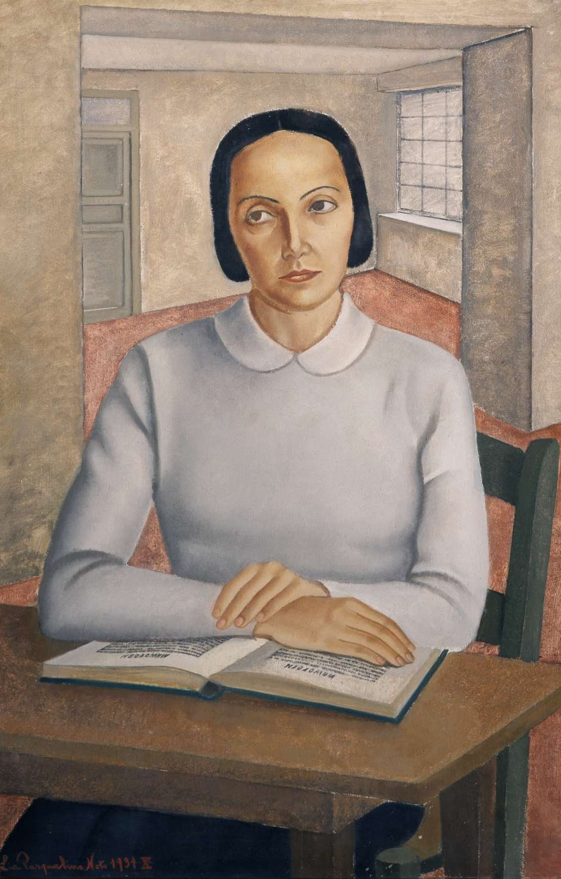
Lia Pasqualino Noto, L’infermiera, 1931, oil on panel
Among the protagonists of the “Sicilian twentieth century” there is also Lia Pasqualino Noto – former exponent of the Group of Four – who in The Nurse (1931) represents in a suspended atmosphere that refers to Magical Realism: a serious and polite woman sitting at a table, with her book, perhaps intent on studying. Behind her, a background with a perspective of geometric constructions. A work in which the sharpness of the contours emerges and a chromatic level with an average tone and a prevalence of grays.
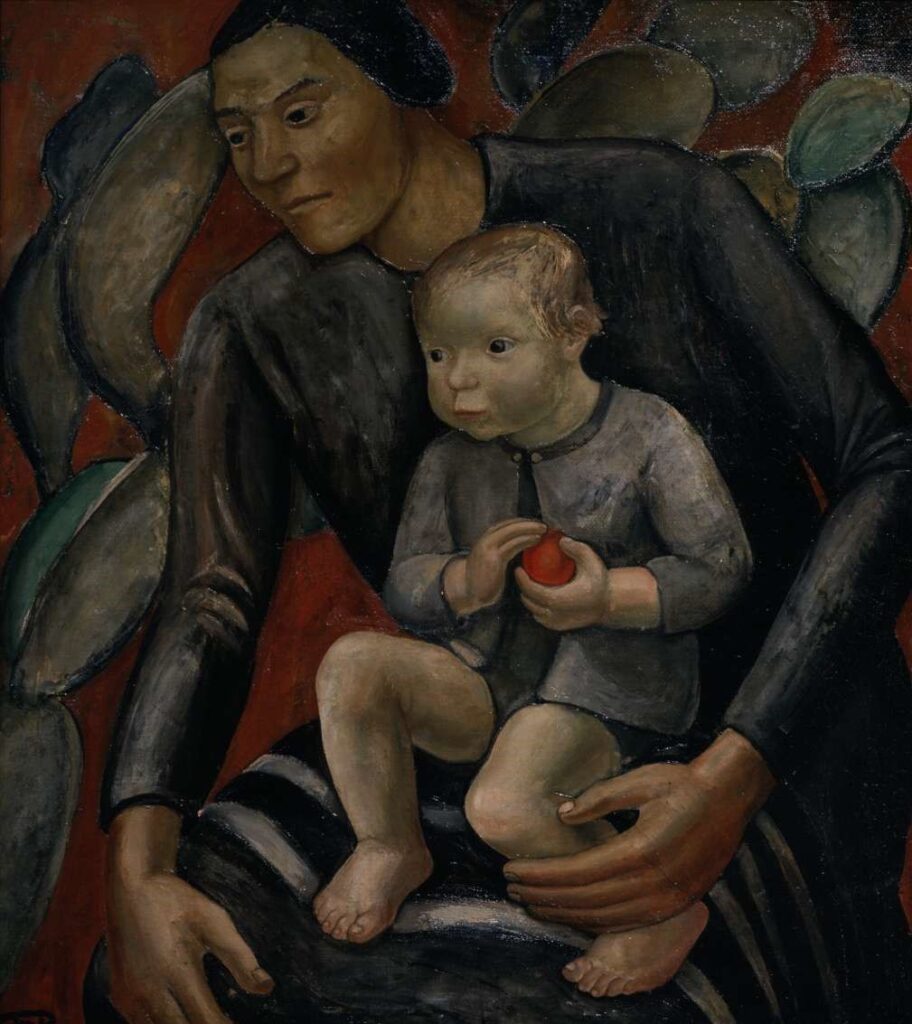
Finally, Woman and Child, is the masterpiece by Elisa Maria Boglino purchased by the Gallery at the Venice Biennale in 1930. This Danish painter who arrived in Palermo in 1927, was involved by Pippo Rizzo in the events of young Sicilian painting, bringing themes and forms of contemporary German painting. In her work, she presents us with a broad-shouldered mother with large hands intent on protecting her child, in the background of which prickly pears are observed (a reference to the Sicilian countryside). The work, which expresses a universal feeling of motherhood, is characterized by the rigorous composition of the masses, combined with a decisive and deliberately anti-naturalist sign.